
- Home
- Mark Twain
Roughing It Page 12
Roughing It Read online
Page 12
"I can tell you a most laughable thing indeed, if you would like to listen to it. Horace Greeley went over this road once. When he was leaving Carson City he told the driver, Hank Monk, that he had an engagement to lecture at Placerville and was very anxious to go through quick. Hank Monk cracked his whip and started off at an awful pace. The coach bounced up and down in such a terrific way that it jolted the buttons all off of Horace's coat, and finally shot his head clean through the roof of the stage, and then he yelled at Hank Monk and begged him to go easier—said he warn't in as much of a hurry as he was awhile ago. But Hank Monk said, 'Keep your seat, Horace, and I'll get you there on time'—and you bet you he did, too, what was left of him!"
A day or two after that we picked up a Denver man at the cross roads, and he told us a good deal about the country and the Gregory Diggings. He seemed a very entertaining person and a man well posted in the affairs of Colorado. By and by he remarked:
"I can tell you a most laughable thing indeed, if you would like to listen to it. Horace Greeley went over this road once. When he was leaving Carson City he told the driver, Hank Monk, that he had an engagement to lecture at Placerville and was very anxious to go through quick. Hank Monk cracked his whip and started off at an awful pace. The coach bounced up and down in such a terrific way that it jolted the buttons all off of Horace's coat, and finally shot his head clean through the roof of the stage, and then he yelled at Hank Monk and begged him to go easier—said he warn't in as much of a hurry as he was awhile ago. But Hank Monk said, 'Keep your seat, Horace, and I'll get you there on time!'—and you bet you he did, too, what was left of him!"
At Fort Bridger, some days after this, we took on board a cavalry sergeant, a very proper and soldierly person indeed. From no other man during the whole journey, did we gather such a store of concise and well- arranged military information. It was surprising to find in the desolate wilds of our country a man so thoroughly acquainted with everything useful to know in his line of life, and yet of such inferior rank and unpretentious bearing. For as much as three hours we listened to him with unabated interest. Finally he got upon the subject of trans- continental travel, and presently said:
"I can tell you a very laughable thing indeed, if you would like to listen to it. Horace Greeley went over this road once. When he was leaving Carson City he told the driver, Hank Monk, that he had an engagement to lecture at Placerville and was very anxious to go through quick. Hank Monk cracked his whip and started off at an awful pace. The coach bounced up and down in such a terrific way that it jolted the buttons all off of Horace's coat, and finally shot his head clean through the roof of the stage, and then he yelled at Hank Monk and begged him to go easier—said he warn't in as much of a hurry as he was awhile ago. But Hank Monk said, 'Keep your seat, Horace, and I'll get you there on time!'—and you bet you he did, too, what was left of him!"
When we were eight hours out from Salt Lake City a Mormon preacher got in with us at a way station—a gentle, soft-spoken, kindly man, and one whom any stranger would warm to at first sight. I can never forget the pathos that was in his voice as he told, in simple language, the story of his people's wanderings and unpitied sufferings. No pulpit eloquence was ever so moving and so beautiful as this outcast's picture of the first Mormon pilgrimage across the plains, struggling sorrowfully onward to the land of its banishment and marking its desolate way with graves and watering it with tears. His words so wrought upon us that it was a relief to us all when the conversation drifted into a more cheerful channel and the natural features of the curious country we were in came under treatment. One matter after another was pleasantly discussed, and at length the stranger said:
"I can tell you a most laughable thing indeed, if you would like to listen to it. Horace Greeley went over this road once. When he was leaving Carson City he told the driver, Hank Monk, that he had an engagement to lecture in Placerville, and was very anxious to go through quick. Hank Monk cracked his whip and started off at an awful pace. The coach bounced up and down in such a terrific way that it jolted the buttons all off of Horace's coat, and finally shot his head clean through the roof of the stage, and then he yelled at Hank Monk and begged him to go easier—said he warn't in as much of a hurry as he was awhile ago. But Hank Monk said, 'Keep your seat, Horace, and I'll get you there on time!'—and you bet you bet you he did, too, what was left of him!"
Ten miles out of Ragtown we found a poor wanderer who had lain down to die. He had walked as long as he could, but his limbs had failed him at last. Hunger and fatigue had conquered him. It would have been inhuman to leave him there. We paid his fare to Carson and lifted him into the coach. It was some little time before he showed any very decided signs of life; but by dint of chafing him and pouring brandy between his lips we finally brought him to a languid consciousness. Then we fed him a little, and by and by he seemed to comprehend the situation and a grateful light softened his eye. We made his mail-sack bed as comfortable as possible, and constructed a pillow for him with our coats. He seemed very thankful. Then he looked up in our faces, and said in a feeble voice that had a tremble of honest emotion in it:
"Gentlemen, I know not who you are, but you have saved my life; and although I can never be able to repay you for it, I feel that I can at least make one hour of your long journey lighter. I take it you are strangers to this great thorough fare, but I am entirely familiar with it. In this connection I can tell you a most laughable thing indeed, if you would like to listen to it. Horace Greeley——"
I said, impressively:
"Suffering stranger, proceed at your peril. You see in me the melancholy wreck of a once stalwart and magnificent manhood. What has brought me to this? That thing which you are about to tell. Gradually but surely, that tiresome old anecdote has sapped my strength, undermined my constitution, withered my life. Pity my helplessness. Spare me only just this once, and tell me about young George Washington and his little hatchet for a change."
We were saved. But not so the invalid. In trying to retain the anecdote in his system he strained himself and died in our arms.
I am aware, now, that I ought not to have asked of the sturdiest citizen of all that region, what I asked of that mere shadow of a man; for, after seven years' residence on the Pacific coast, I know that no passenger or driver on the Overland ever corked that anecdote in, when a stranger was by, and survived. Within a period of six years I crossed and recrossed the Sierras between Nevada and California thirteen times by stage and listened to that deathless incident four hundred and eighty-one or eighty-two times. I have the list somewhere. Drivers always told it, conductors told it, landlords told it, chance passengers told it, the very Chinamen and vagrant Indians recounted it. I have had the same driver tell it to me two or three times in the same afternoon. It has come to me in all the multitude of tongues that Babel bequeathed to earth, and flavored with whiskey, brandy, beer, cologne, sozodont, tobacco, garlic, onions, grasshoppers—everything that has a fragrance to it through all the long list of things that are gorged or guzzled by the sons of men. I never have smelt any anecdote as often as I have smelt that one; never have smelt any anecdote that smelt so variegated as that one. And you never could learn to know it by its smell, because every time you thought you had learned the smell of it, it would turn up with a different smell. Bayard Taylor has written about this hoary anecdote, Richardson has published it; so have Jones, Smith, Johnson, Ross Browne, and every other correspondence-inditing being that ever set his foot upon the great overland road anywhere between Julesburg and San Francisco; and I have heard that it is in the Talmud. I have seen it in print in nine different foreign languages; I have been told that it is employed in the inquisition in Rome; and I now learn with regret that it is going to be set to music. I do not think that such things are right.
Stage-coaching on the Overland is no more, and stage drivers are a race defunct. I wonder if they bequeathed that bald-headed anecdote to their successors, the railroad brakemen and conductors, and if these
latter still persecute the helpless passenger with it until he concludes, as did many a tourist of other days, that the real grandeurs of the Pacific coast are not Yo Semite and the Big Trees, but Hank Monk and his adventure with Horace Greeley.
[And what makes that worn anecdote the more aggravating, is, that the adventure it celebrates never occurred. If it were a good anecdote, that seeming demerit would be its chiefest virtue, for creative power belongs to greatness; but what ought to be done to a man who would wantonly contrive so flat a one as this? If I were to suggest what ought to be done to him, I should be called extravagant—but what does the sixteenth chapter of Daniel say? Aha!]
Part 3
CHAPTER XXI.
Alkali Dust—Desolation and Contemplation—Carson City—Our Journey Ended—We are Introduced to Several Citizens—A Strange Rebuke—A Washoe Zephyr at Play—Its Office Hours—Governor's Palace—Government Offices—Our French Landlady Bridget O'Flannigan—Shadow Secrets—Cause for a Disturbance at Once—The Irish Brigade—Mrs. O'Flannigan's Boarders—The Surveying Expedition—Escape of the Tarantulas
We were approaching the end of our long journey. It was the morning of the twentieth day. At noon we would reach Carson City, the capital of Nevada Territory. We were not glad, but sorry. It had been a fine pleasure trip; we had fed fat on wonders every day; we were now well accustomed to stage life, and very fond of it; so the idea of coming to a stand-still and settling down to a humdrum existence in a village was not agreeable, but on the contrary depressing.
Visibly our new home was a desert, walled in by barren, snow-clad mountains. There was not a tree in sight. There was no vegetation but the endless sage-brush and greasewood. All nature was gray with it. We were plowing through great deeps of powdery alkali dust that rose in thick clouds and floated across the plain like smoke from a burning house.
We were coated with it like millers; so were the coach, the mules, the mail-bags, the driver—we and the sage-brush and the other scenery were all one monotonous color. Long trains of freight wagons in the distance envelope in ascending masses of dust suggested pictures of prairies on fire. These teams and their masters were the only life we saw. Otherwise we moved in the midst of solitude, silence and desolation. Every twenty steps we passed the skeleton of some dead beast of burthen, with its dust-coated skin stretched tightly over its empty ribs. Frequently a solemn raven sat upon the skull or the hips and contemplated the passing coach with meditative serenity.
By and by Carson City was pointed out to us. It nestled in the edge of a great plain and was a sufficient number of miles away to look like an assemblage of mere white spots in the shadow of a grim range of mountains overlooking it, whose summits seemed lifted clear out of companionship and consciousness of earthly things.
We arrived, disembarked, and the stage went on. It was a "wooden" town; its population two thousand souls. The main street consisted of four or five blocks of little white frame stores which were too high to sit down on, but not too high for various other purposes; in fact, hardly high enough. They were packed close together, side by side, as if room were scarce in that mighty plain.
The sidewalk was of boards that were more or less loose and inclined to rattle when walked upon. In the middle of the town, opposite the stores, was the "plaza" which is native to all towns beyond the Rocky Mountains—a large, unfenced, level vacancy, with a liberty pole in it, and very useful as a place for public auctions, horse trades, and mass meetings, and likewise for teamsters to camp in. Two other sides of the plaza were faced by stores, offices and stables.
The rest of Carson City was pretty scattering.
We were introduced to several citizens, at the stage-office and on the way up to the Governor's from the hotel—among others, to a Mr. Harris, who was on horseback; he began to say something, but interrupted himself with the remark:
"I'll have to get you to excuse me a minute; yonder is the witness that swore I helped to rob the California coach—a piece of impertinent intermeddling, sir, for I am not even acquainted with the man."
Then he rode over and began to rebuke the stranger with a six-shooter, and the stranger began to explain with another. When the pistols were emptied, the stranger resumed his work (mending a whip-lash), and Mr. Harris rode by with a polite nod, homeward bound, with a bullet through one of his lungs, and several in his hips; and from them issued little rivulets of blood that coursed down the horse's sides and made the animal look quite picturesque. I never saw Harris shoot a man after that but it recalled to mind that first day in Carson.
This was all we saw that day, for it was two o'clock, now, and according to custom the daily "Washoe Zephyr" set in; a soaring dust-drift about the size of the United States set up edgewise came with it, and the capital of Nevada Territory disappeared from view.
Still, there were sights to be seen which were not wholly uninteresting to new comers; for the vast dust cloud was thickly freckled with things strange to the upper air—things living and dead, that flitted hither and thither, going and coming, appearing and disappearing among the rolling billows of dust—hats, chickens and parasols sailing in the remote heavens; blankets, tin signs, sage-brush and shingles a shade lower; door-mats and buffalo robes lower still; shovels and coal scuttles on the next grade; glass doors, cats and little children on the next; disrupted lumber yards, light buggies and wheelbarrows on the next; and down only thirty or forty feet above ground was a scurrying storm of emigrating roofs and vacant lots.
It was something to see that much. I could have seen more, if I could have kept the dust out of my eyes.
But seriously a Washoe wind is by no means a trifling matter. It blows flimsy houses down, lifts shingle roofs occasionally, rolls up tin ones like sheet music, now and then blows a stage coach over and spills the passengers; and tradition says the reason there are so many bald people there, is, that the wind blows the hair off their heads while they are looking skyward after their hats. Carson streets seldom look inactive on Summer afternoons, because there are so many citizens skipping around their escaping hats, like chambermaids trying to head off a spider.
The "Washoe Zephyr" (Washoe is a pet nickname for Nevada) is a peculiar Scriptural wind, in that no man knoweth "whence it cometh." That is to say, where it originates. It comes right over the mountains from the West, but when one crosses the ridge he does not find any of it on the other side! It probably is manufactured on the mountain-top for the occasion, and starts from there. It is a pretty regular wind, in the summer time. Its office hours are from two in the afternoon till two the next morning; and anybody venturing abroad during those twelve hours needs to allow for the wind or he will bring up a mile or two to leeward of the point he is aiming at. And yet the first complaint a Washoe visitor to San Francisco makes, is that the sea winds blow so, there! There is a good deal of human nature in that.
We found the state palace of the Governor of Nevada Territory to consist of a white frame one-story house with two small rooms in it and a stanchion supported shed in front—for grandeur—it compelled the respect of the citizen and inspired the Indians with awe. The newly arrived Chief and Associate Justices of the Territory, and other machinery of the government, were domiciled with less splendor. They were boarding around privately, and had their offices in their bedrooms.
The Secretary and I took quarters in the "ranch" of a worthy French lady by the name of Bridget O'Flannigan, a camp follower of his Excellency the Governor. She had known him in his prosperity as commander-in-chief of the Metropolitan Police of New York, and she would not desert him in his adversity as Governor of Nevada.
Our room was on the lower floor, facing the plaza, and when we had got our bed, a small table, two chairs, the government fire-proof safe, and the Unabridged Dictionary into it, there was still room enough left for a visitor—may be two, but not without straining the walls. But the walls could stand it—at least the partitions could, for they consisted simply of one thickness of white "cotton domestic" stretched from corner to
corner of the room. This was the rule in Carson—any other kind of partition was the rare exception. And if you stood in a dark room and your neighbors in the next had lights, the shadows on your canvas told queer secrets sometimes! Very often these partitions were made of old flour sacks basted together; and then the difference between the common herd and the aristocracy was, that the common herd had unornamented sacks, while the walls of the aristocrat were overpowering with rudimental fresco—i.e., red and blue mill brands on the flour sacks.
Occasionally, also, the better classes embellished their canvas by pasting pictures from Harper's Weekly on them. In many cases, too, the wealthy and the cultured rose to spittoons and other evidences of a sumptuous and luxurious taste. [Washoe people take a joke so hard that I must explain that the above description was only the rule; there were many honorable exceptions in Carson—plastered ceilings and houses that had considerable furniture in them.—M. T.]
We had a carpet and a genuine queen's-ware washbowl. Consequently we were hated without reserve by the other tenants of the O'Flannigan "ranch." When we added a painted oilcloth window curtain, we simply took our lives into our own hands. To prevent bloodshed I removed up stairs and took up quarters with the untitled plebeians in one of the fourteen white pine cot-bedsteads that stood in two long ranks in the one sole room of which the second story consisted.
It was a jolly company, the fourteen. They were principally voluntary camp-followers of the Governor, who had joined his retinue by their own election at New York and San Francisco and came along, feeling that in the scuffle for little territorial crumbs and offices they could not make their condition more precarious than it was, and might reasonably expect to make it better. They were popularly known as the "Irish Brigade," though there were only four or five Irishmen among all the Governor's retainers.
 A Connecticut Yankee in King Arthur's Court
 Adventures of Huckleberry Finn
 The Adventures of Tom Sawyer, Part 1.
 The Prince and the Pauper
 The American Claimant
 Eve's Diary, Complete
 Extracts from Adam's Diary, translated from the original ms.
 A Tramp Abroad
 The Best Short Works of Mark Twain
 Humorous Hits and How to Hold an Audience
 The Speculative Fiction of Mark Twain
 The Facts Concerning the Recent Carnival of Crime in Connecticut
 Alonzo Fitz, and Other Stories
 The $30,000 Bequest, and Other Stories
 Pudd'nhead Wilson and Those Extraordinary Twins
 The Adventures of Huckleberry Finn and the Undead
 Sketches New and Old
 The Man That Corrupted Hadleyburg
 A Tramp Abroad — Volume 06
 A Tramp Abroad — Volume 02
 The Prince and the Pauper, Part 1.
 Adventures of Huckleberry Finn, Chapters 16 to 20
 The Prince and the Pauper, Part 9.
 Adventures of Huckleberry Finn, Chapters 21 to 25
 Tom Sawyer, Detective
 A Tramp Abroad (Penguin ed.)
 Adventures of Huckleberry Finn, Chapters 36 to the Last
 The Mysterious Stranger, and Other Stories
 A Tramp Abroad — Volume 03
 The Adventures of Tom Sawyer, Part 3.
 Adventures of Huckleberry Finn, Chapters 06 to 10
_preview.jpg) The Adventures of Huckleberry Finn (Tom Sawyer's Comrade)
The Adventures of Huckleberry Finn (Tom Sawyer's Comrade) Adventures of Huckleberry Finn, Chapters 31 to 35
 The Man That Corrupted Hadleyburg, and Other Stories
 A Tramp Abroad — Volume 07
 Editorial Wild Oats
 Adventures of Huckleberry Finn, Chapters 26 to 30
 1601: Conversation as it was by the Social Fireside in the Time of the Tudors
 A Tramp Abroad — Volume 05
 Sketches New and Old, Part 1.
 The Adventures of Tom Sawyer, Part 2.
 A Connecticut Yankee in King Arthur's Court, Part 8.
 A Tramp Abroad — Volume 01
 The Adventures of Tom Sawyer, Part 5.
 Adventures of Huckleberry Finn, Chapters 01 to 05
 A Connecticut Yankee in King Arthur's Court, Part 1.
 The Adventures of Tom Sawyer, Part 4.
 A Connecticut Yankee in King Arthur's Court, Part 2.
 The Adventures of Tom Sawyer, Part 7.
 A Connecticut Yankee in King Arthur's Court, Part 3.
 Sketches New and Old, Part 4.
 Sketches New and Old, Part 3.
 A Connecticut Yankee in King Arthur's Court, Part 7.
 A Connecticut Yankee in King Arthur's Court, Part 5.
 A Connecticut Yankee in King Arthur's Court, Part 6.
 A Connecticut Yankee in King Arthur's Court, Part 4.
 Sketches New and Old, Part 2.
 Sketches New and Old, Part 6.
 Adventures of Huckleberry Finn, Chapters 11 to 15
 Personal Recollections of Joan of Arc
 Sketches New and Old, Part 5.
 Eve's Diary, Part 3
 Sketches New and Old, Part 7.
 Mark Twain on Religion: What Is Man, the War Prayer, Thou Shalt Not Kill, the Fly, Letters From the Earth
 Tales, Speeches, Essays, and Sketches
 A Connecticut Yankee in King Arthur's Court, Part 9.
 Our Fellow Savages of the Sandwich Islands (version 1)
 1601
1601 Letters from the Earth
 Curious Republic Of Gondour, And Other Curious Whimsical Sketches
 The Mysterious Stranger
 Life on the Mississippi
 Roughing It
 Alonzo Fitz and Other Stories
 The 30,000 Dollar Bequest and Other Stories
 The Adventures of Huckleberry Finn taots-2
 A Double-Barreled Detective Story
 adam's diary.txt
 A Horse's Tale
 Autobiography Of Mark Twain, Volume 1
 The Comedy of Those Extraordinary Twins
 Following the Equator
 Goldsmith's Friend Abroad Again
 No. 44, The Mysterious Stranger
 The Stolen White Elephant
 The $30,000 Bequest and Other Stories
 The Curious Republic of Gondour, and Other Whimsical Sketches
 Prince and the Pauper (Barnes & Noble Classics Series)
 The Portable Mark Twain
 Connecticut Yankee in King Arthur's Court (Barnes & Noble Classics Series)
 The Adventures of Tom Sawyer taots-1
 A Double Barrelled Detective Story
 Eve's Diary
 A Dog's Tale
 The Mysterious Stranger Manuscripts (Literature)
 The Complete Short Stories of Mark Twain
 What Is Man? and Other Essays
 The Adventures of Huckleberry Finn
 Adventures of Huckleberry Finn and Zombie Jim
 Who Is Mark Twain?
 Christian Science
 The Innocents Abroad
 Some Rambling Notes of an Idle Excursion
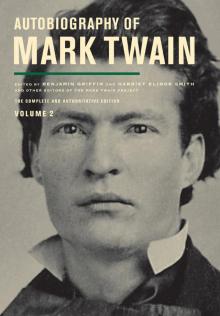 Autobiography of Mark Twain
 Those Extraordinary Twins
 Autobiography of Mark Twain: The Complete and Authoritative Edition, Volume 1